 By ali4050284
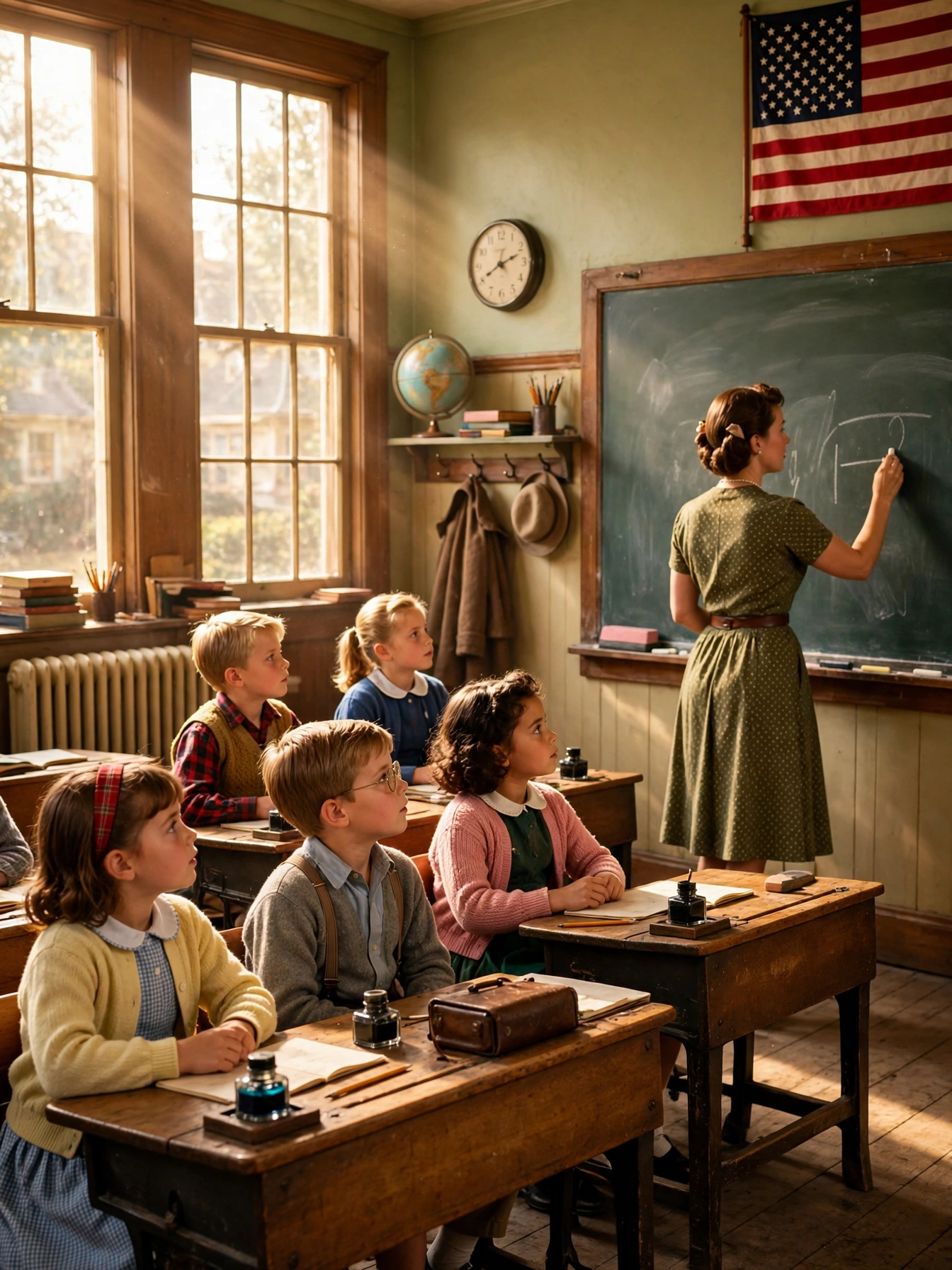
If you grew up in the 1950s, you did not need an alarm clock to get to school. You walked. Most children lived close enough to their school to walk there in a group, rain or shine, with a lunch pail swinging from one hand and a book satchel from the other. The crossing guard in her white belt and the smell of chalk dust in the hallway were the first things you met each morning — and the school bell, rung by hand, told you exactly when the day began.
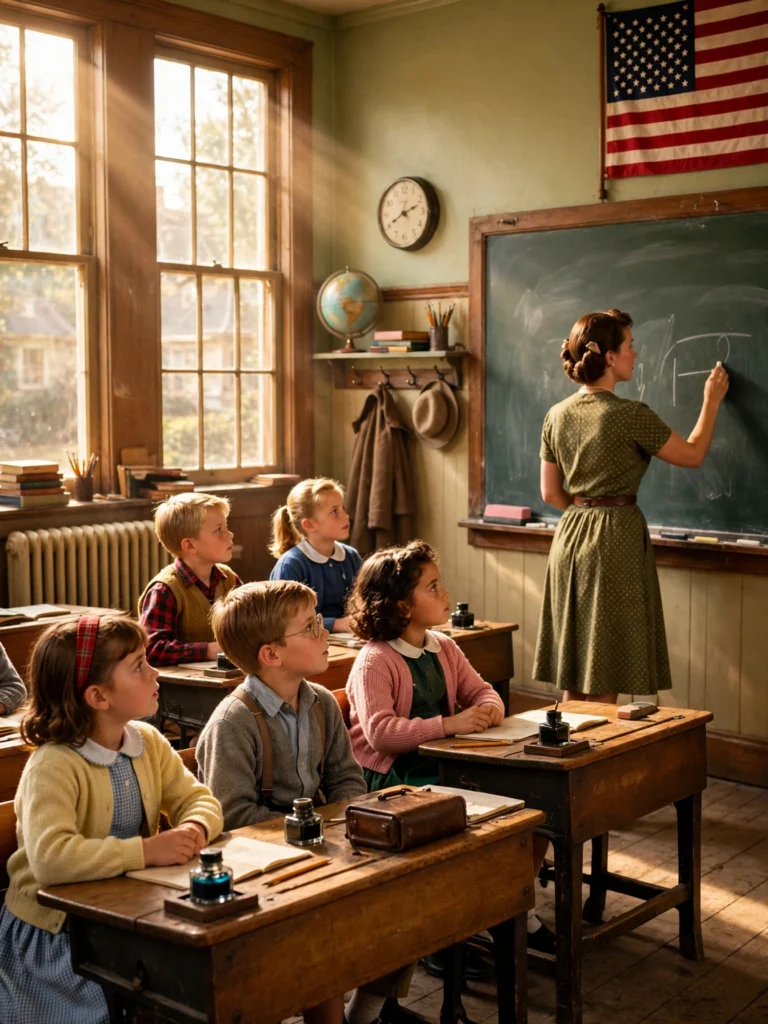
The classroom itself
The 1950s classroom looked nothing like the classrooms of today. Rows of wooden desks were bolted to the floor in neat lines, each one with a round hole in the top right corner for a glass inkwell. The teacher’s desk stood at the front, and behind it stretched a huge green chalkboard that ran almost the whole width of the wall. Above the board hung a clock with big black numbers, a portrait of the president, and the American flag in its wooden stand. There was a globe on a shelf, a wall map that pulled down like a window blind, and a pencil sharpener screwed to the wall by the door that every child wanted to be sent to use.
There were no computers, no projectors, no whiteboards. The teacher wrote everything in chalk, and the chalk dust floated in the sunlight from the tall windows. If you were lucky, you got to be the one who stayed after school to clap the erasers together outside — the dusty cloud that came off them was considered a privilege, not a punishment.
Cursive, ink and penmanship
The most serious business of the school day was penmanship. Children began with fat pencils and wide-ruled paper, learning to print their letters one by one. Then came cursive — the flowing, looped handwriting that every adult used. The teacher showed each letter on the board in perfect loops, and the class copied them row after row in their copybooks. Good handwriting was a mark of character, and a report card could praise or scold you for it.
Then came the ink. Older children graduated to fountain pens, dipping their nibs into the glass inkwell set into the desk. A blot on the page was a small disaster, and an ink stain on your fingers was the mark of a serious student. Many adults who grew up in that decade still write in the same careful cursive today, because the loops they practiced in third grade never left their hands.
The milk break and the lunch pail
At about ten in the morning, the whole school stopped for the milk break. Small glass bottles of milk arrived in wooden crates, and each child got one, along with a paper straw. On cold days the milk was sometimes left by the radiator and went warm, and on the coldest winter mornings it arrived half-frozen — but nobody complained, because the milk break meant a few minutes of rest and gossip.
Lunch was eaten at your desk, from a metal lunch pail or a paper bag. A sandwich wrapped in wax paper, an apple, maybe a cookie if your mother had baked that week. There were no cafeterias in many schools, and no choices: you ate what was packed for you, and you traded with your friends if you were lucky. The boy with the peanut butter sandwich always wanted the boy with the bologna, and the trade was serious business.
The teacher knew everyone
The teacher in a 1950s school was a figure of real authority. She — and it was usually a she — knew every child by name, knew their parents, and knew which of them had done their homework and which had not. She called the roll every morning, and if you were absent, your mother had to write a note explaining why. Classes were big, sometimes forty children to a room, but discipline was simple: you sat up straight, you raised your hand, and you did not talk out of turn. And yet, for all the rules, most people who went through those schools remember their teachers with real affection — the one who read aloud after lunch, the one who stayed late to help with arithmetic, the one who believed a shy child could do more.
Duck and cover
The 1950s classroom also carried the worries of its time. Every few weeks the bell would ring in a different pattern, and the teacher would say, “Duck and cover.” Children would slip under their desks, cover their heads with their arms, and wait in silence until the all-clear. They were drills for a war that never came, and the children treated them the way children treat everything — half seriously, half as a game. It seems strange now, but at the time it was simply part of the school day, like the spelling test on Friday.
Walking home
When the final bell rang at three o’clock, the children poured out of the doors in a rush — but nobody went straight home. The walk home was the best part of the day. Stopping to look in shop windows, collecting chestnuts in the fall, kicking a stone all the way down the block. Homework waited on the kitchen table, and supper was at six, and the whole slow, safe rhythm of it felt like it would never change. It did change, of course. But if you close your eyes, you can still hear that hand-rung bell, smell the chalk dust, and see the teacher writing the day’s date on the board in her perfect cursive hand.