 By ali4050284
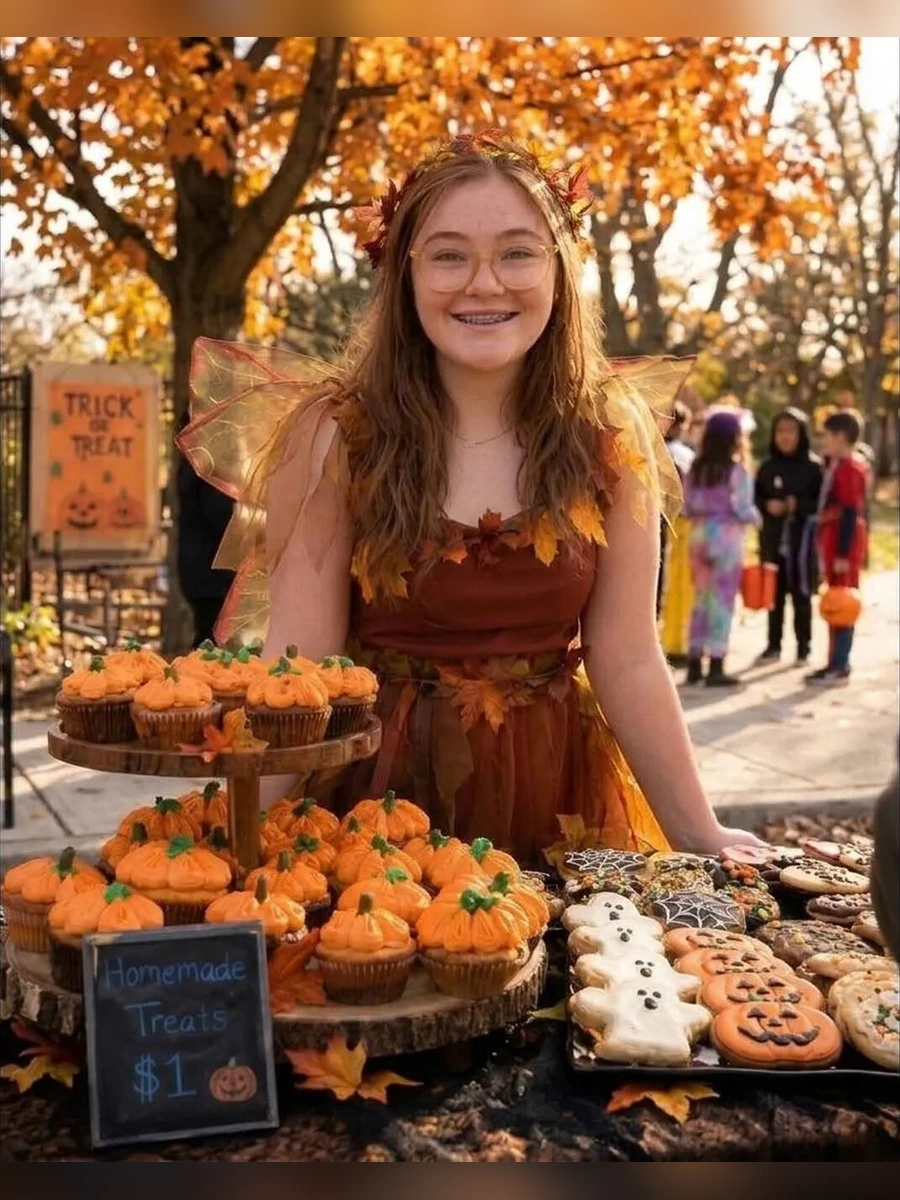
Ruby had always loved baking. Give her flour, frosting and a piping bag, and she could spend hours working on the tiniest details, completely absorbed in a world of colour and careful lines. She was fourteen, quiet, and autistic, and while noisy crowds and small talk were hard for her, a kitchen was a place where she felt completely at ease. She measured, mixed, decorated and tasted with a focus that amazed everyone who watched her.
So when her school announced a Halloween fair, Ruby did something brave. She volunteered to run a bake sale table. For three evenings in a row, she worked in the kitchen after school, making pumpkin cupcakes, ghost-shaped cookies, spiderweb biscuits and chocolate treats decorated with orange and black frosting. Every tray looked beautiful, and by the third evening the kitchen counters were covered with boxes of treats, each one finished with the same care Ruby gave to everything she made.
Her mother, Claire, helped her carry everything into school and arrange it on the table. They set out the cupcakes in neat rows, placed the cookies on stands, and put up a small hand-painted sign that read “Homemade Treats”. Ruby stood behind her table, straightened the last tray, and smiled. She had been looking forward to this fair for weeks, and she was ready.
Twenty Minutes Before the Fair
About twenty minutes before the fair started, Claire stepped away to fetch drinks for them both. It was a short errand, and she expected to be back in a couple of minutes. But when she returned, something had changed at Ruby’s table, and her heart sank.
Another girl was sitting in Ruby’s chair, arranging the treats in a completely different order. Ruby herself was standing a few steps behind the table, holding her hands tightly together, looking as though she might cry. Beside the table stood the other girl’s mother, Dana, who was well known at the school as the chair of the parent committee and one of the organisers of the fair.
Claire walked over quickly and asked what was happening. Dana smiled as if nothing unusual had taken place and explained that, as an organiser, she had made a few small changes. Her daughter, Chloe, would be running this table now. She spoke as though the decision had already been settled, and as though Ruby’s feelings about it did not matter at all.
Claire felt her throat go dry. She asked why. Dana lowered her voice and said that Ruby barely spoke to anyone, while Chloe knew how to talk to people. They were trying to raise money, she said, and Ruby would be better off standing in the back.
A Quiet Girl Who Had Worked So Hard
Claire looked at her daughter. Ruby had spent three evenings baking every single treat on that table. She had chosen the recipes, mixed the batter, piped the frosting and packed each box herself. The idea that she should now stand at the back while someone else took the credit for her work was not just unfair. It was cruel.
Ruby is autistic, and she is shy. Talking to dozens of strangers in one day really was difficult for her, and Claire knew that better than anyone. But difficulty is not the same as inability, and Ruby had been trying very hard. She had practised greeting customers at home. She had prepared a small script for herself, with the prices written on a card she could glance at. She had wanted this chance, and she had earned it.
Claire also knew something Dana did not seem to understand. A school fair is not only about raising money. It is about giving every child a chance to take part, to be proud of what they have made, and to belong. Taking Ruby’s table away because she was quiet sent exactly the wrong message, not only to Ruby but to every other child watching.
She asked Dana, calmly, to give Ruby her table back. She explained that what was happening was not appropriate, and that Ruby had every right to run the table she had volunteered for and stocked herself. Dana laughed and said that she was in charge of organising the tables, that her daughter would be better at selling, and that the matter was settled. She made it clear that she was not going anywhere.
The Moment Claire Decided to Act
Something inside Claire snapped, but not in anger. It snapped into clarity. She was not going to argue with Dana in front of a growing crowd of children, and she was not going to let her daughter be pushed aside quietly either. So she smiled at Dana and said something Dana did not expect.
“You know what? You’re right. We’ll leave.”
Dana smiled, satisfied, and turned back to rearranging the treats. Chloe looked uncomfortable, as if she knew this was not right but did not know how to say so. Ruby looked confused and frightened, and Claire took her hand and squeezed it gently, silently telling her to trust her.
Then Claire walked to the middle of the fair, reached into her bag, and pulled something out where everyone could see it. It was a folder, and inside it were the fair’s own rules, printed and signed by the school, along with the volunteer form Ruby had filled in weeks earlier. The form clearly named Ruby as the volunteer responsible for the bake sale table. The rules clearly stated that tables were assigned to the students who volunteered for them, and that no parent could reassign a table without the school’s agreement.
Claire did not shout. She did not need to. She simply held up the form and read the relevant lines aloud, calmly, so that the parents nearby could hear. The effect was immediate. Conversations stopped. Parents turned to look. And Dana, who had been so confident a moment earlier, went pale.
What the Fair Rules Actually Said
The rules were simple and fair. Each student who volunteered for a stall was responsible for it. Parents could help, but they could not take a stall over for their own child. Changes to assignments had to be approved by the teacher in charge of the fair. None of that had happened here. Dana had simply decided, on her own authority, that her daughter would be better at the job, and had acted as though her committee role gave her the right to override the school’s own system.
A teacher who had been setting up nearby came over to see what was happening. Claire showed her the form and explained the situation quietly. The teacher read the volunteer form, looked at the table full of Ruby’s baking, and nodded. She turned to Dana and asked her to step aside so that Ruby could return to her table. Dana tried to argue, but the teacher was firm. The rules were the rules, and they applied to everyone, including committee chairs.
Dana’s face flushed. She told Chloe to come with her, and the two of them walked away from the table. Chloe glanced back at Ruby with an apologetic look, and Ruby, still shaken, managed a small wave. Claire put her arm around her daughter and whispered that she had done nothing wrong, and that she was proud of her.
Ruby’s Table Comes Alive
Once Ruby was back behind her table, something wonderful happened. Word spread quickly around the fair that the girl who had baked all those beautiful treats was running the stall herself, and visitors began to stop by in growing numbers. Ruby greeted them with her practised words, pointed to the price card when she needed to, and let her baking do most of the talking. It did a very good job of it.
The pumpkin cupcakes sold first, then the ghost cookies, then the spiderweb biscuits. Parents asked Ruby how she had made the frosting so neat. Younger children stared at the trays with wide eyes and pointed at their favourites. Ruby answered questions in her own quiet way, and the more people smiled at her, the more confident she became. By the middle of the fair, her table was one of the busiest in the hall.
Claire stood nearby, close enough to help if Ruby needed her, but far enough back to let her daughter shine. She watched Ruby count change carefully, wrap treats in paper bags, and thank each customer. It was everything Ruby had hoped the fair would be, and it was happening because she had been given the chance she deserved.
A Lesson for the Whole School
Before the fair ended, the teacher in charge made a short announcement. She thanked all the volunteers, and she reminded everyone that the fair belonged to the students. She said that every child who volunteered deserved to be treated fairly, and that kindness and inclusion were just as important as the money raised. She did not name Dana, but everyone understood what she meant, and several parents nodded.
Dana did not return to Ruby’s table. Later, Claire heard that the teacher had spoken to her privately about respecting the volunteer system. Chloe, to her credit, came back on her own before the end of the fair, bought a pumpkin cupcake, and told Ruby it was delicious. Ruby smiled, and the two girls chatted for a moment about baking, like any two classmates might.
That small exchange mattered as much as anything else that day. It showed that the problem had never been between the children. It had been an adult’s decision to put one child ahead of another, and once that decision was undone, the children got along just fine.
Conclusion
Ruby’s Halloween fair ended with an empty table, a full money box, and a girl who walked out of school taller than she had walked in. She had baked the treats, defended her place with her mother’s help, and proved to herself that quiet people can stand their ground too. Claire had not set out to embarrass anyone. She had simply used the fair’s own rules, calmly and in the open, to make sure her daughter was treated fairly.
The story of Ruby’s table is a reminder that inclusion is not a favour adults grant to quiet children. It is a right, and it is protected by the same simple fairness that should govern every school event. When a child works hard, volunteers bravely and shows up ready, she deserves her place at the table. Ruby earned hers three evenings in a row, one tray of cupcakes at a time, and no one had the right to take it away.