 By ali4050284
Granny Pearl had won the county fair jam contest twelve years in a row, and everybody in Holler County agreed it was not a fair fight. Her blackberry jam was so good that the judges had once tried to disqualify her on the grounds that no human being could make jam that good, and had only relented when Pearl threatened to stop bringing her fried apple pies to the church social.
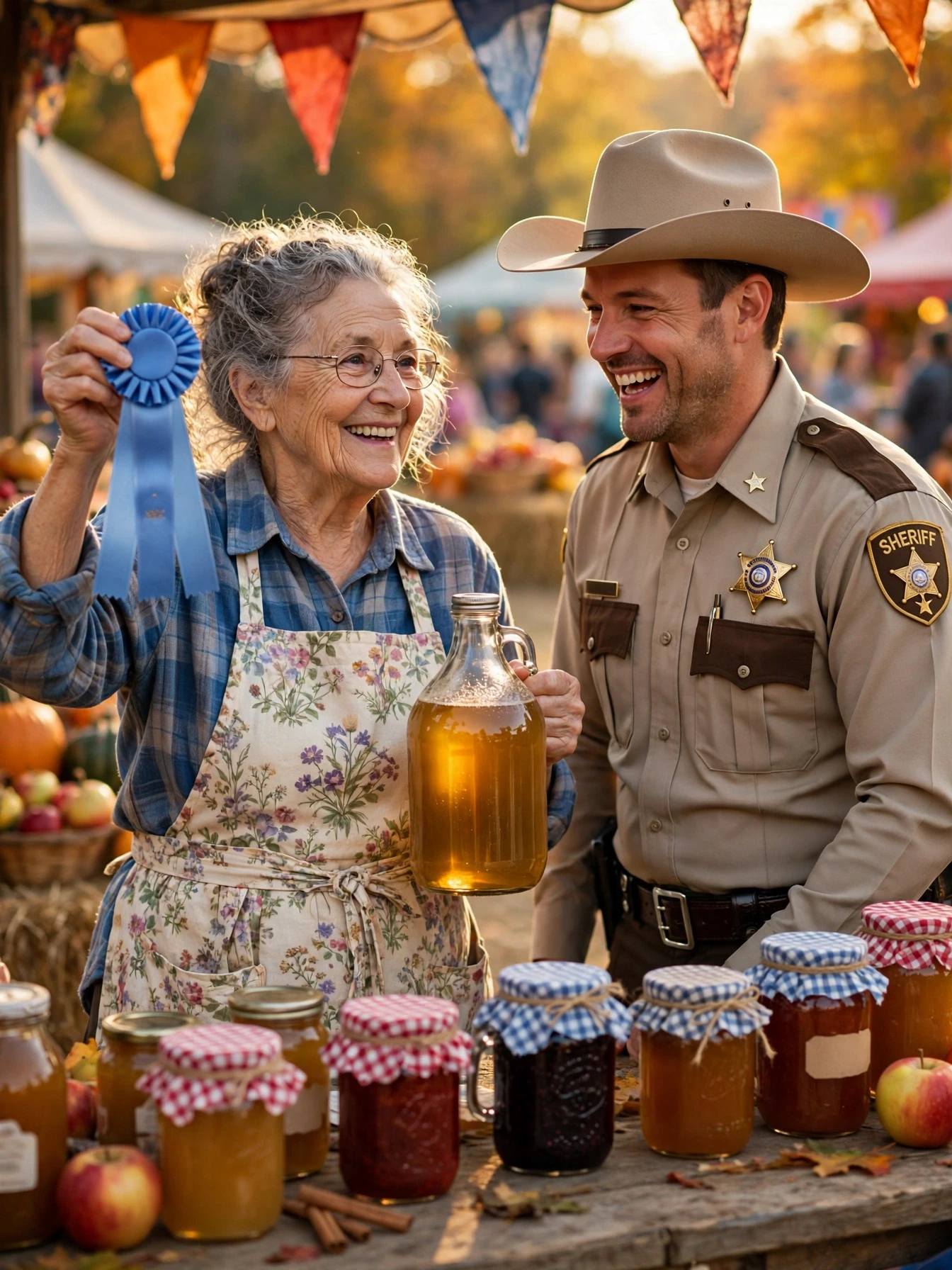
This year, though, Pearl had a surprise. She was not entering jam. She was entering the cider contest.
“Apple cider?” her grandson Tommy said, when she told him. “Granny, you never made cider in your life.”
“There’s a first time for everything,” Pearl said, wiping her hands on her apron. “And this cider is my late husband’s recipe. Earl’s daddy taught it to him, and Earl taught it to me, and I aim to see it win a ribbon before I die.”
Tommy did not ask what was in Earl’s daddy’s recipe. In Holler County, there were some questions you did not ask your grandmother, and the contents of a glass jug in her pantry was one of them.
On the morning of the fair, Pearl carried her jug to the preserves tent herself, all five foot two of her, in her best dress and her good hat. She set the jug on the judges’ table next to the other entries — a thin, pale cider from the Hendersons, a cloudy one from the Miller boys that smelled faintly of feet — and she folded her arms and waited.
The judges tasted the Hendersons’ cider first. They nodded politely. They tasted the Miller boys’ cider and made faces they tried very hard to hide. And then the head judge, a stern woman named Mrs. Whitfield who had judged preserves for thirty years and had never once smiled at a jar of anything, lifted Pearl’s jug and poured herself a small glass.
She took one sip. Her eyebrows went up. She took a second sip, a bigger one. Then she looked at Pearl, and for the first time in thirty years, Mrs. Whitfield smiled.
“Ladies and gentlemen,” she announced, “we have a winner, and it is not close. This is the finest apple cider ever entered in this fair.”
The crowd cheered. Pearl beamed. The blue ribbon was pinned to her jug, and the photographer from the county paper took a picture of her holding it up like a trophy, and Pearl waved at the camera and said, “I told you Earl’s recipe was the best.”
That was when Sheriff Dale arrived.
Sheriff Dale was a good man and a fair man, and he had one weakness, which was that he could not resist a county fair. He had come for a funnel cake, and he had stayed for the pie-eating contest, and now he wandered over to the preserves tent to congratulate Pearl, because everybody in the county loved Pearl, and because somebody had told him the winning cider was the best thing they had ever tasted.
“Granny Pearl,” Dale said, tipping his hat, “I hear you won yourself a ribbon. Let me taste the champion.”
Pearl hesitated — just for a second, just long enough for Dale to notice. But she was Pearl, and Pearl never backed down from anything, so she poured him a glass.
Dale took a sip. And his face went white.
Because Dale knew cider. And Dale knew something else. What was in that glass was not cider. It was the smoothest, strongest, most illegal apple moonshine Dale had tasted since he was a deputy and his own granddaddy had poured him a thimbleful behind the barn and told him never to tell his mother.
Pearl watched him. The whole tent watched him. Mrs. Whitfield watched him. Tommy, who had just arrived with a funnel cake, watched him.
Dale looked at the jug. He looked at the blue ribbon. He looked at Pearl, eighty-two years old, five foot two, standing there in her good hat with her chin up, daring him to do his job.
And Dale did what any sheriff in Holler County would do.
“Well,” he said, very loudly, so the whole tent could hear, “this here is evidence.” He lifted the jug. “And as sheriff, I am required by law to confiscate this evidence immediately, and dispose of it properly, in the presence of witnesses.”
Then he took a long drink straight from the jug, wiped his mouth, and handed it to Mrs. Whitfield.
“For the record,” Mrs. Whitfield said, taking her own long drink, “this evidence is delicious.”
The jug went around the tent. The judges drank. The preacher drank — just a little, for medicinal purposes, he said. Even Tommy had a sip and coughed so hard his eyes watered, which made Pearl laugh so hard she had to sit down.
By sunset, the jug was empty, the evidence was gone, and the blue ribbon was still pinned to Pearl’s dress, right where it belonged. Dale drove her home himself, very slowly, with the siren off and the windows down, and Pearl sang an old song the whole way, slightly off-key.
“Granny,” Tommy said the next morning, when she was making biscuits like nothing had happened, “are you going to get in trouble?”
Pearl snorted. “Trouble? Tommy, honey, that sheriff drank the evidence. There is no evidence. There is only a ribbon, and a recipe, and a secret. And secrets in this family go to the grave.”
She paused, and then she grinned, the same grin she had worn when she won her first jam contest forty years ago.
“Next year,” she said, “I’m entering the grape juice.”