 By ali4050284
Every granny has a handbag, and every handbag is a mystery. It looks like an ordinary bag — a little worn, a little heavy, with a clasp that has been repaired twice. But open it, and you will discover that it is not a bag at all. It is a hardware store, a pharmacy, a sweet shop, and a family archive, all stuffed into one leather miracle. Scientists have studied the Bermuda Triangle. They should have studied Granny’s handbag instead. Here are the twelve things she never leaves home without — and yes, they are all in there at the same time.
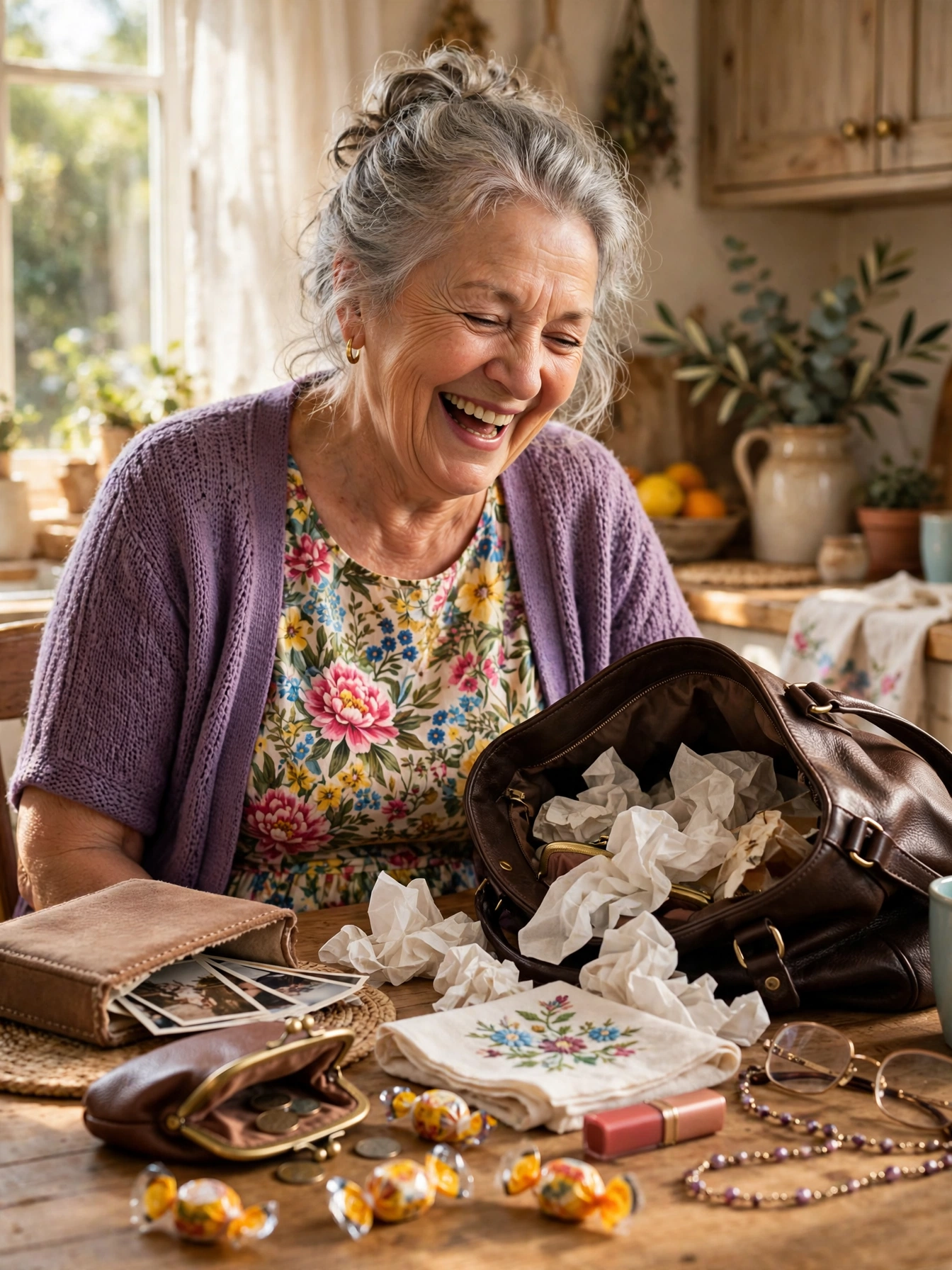
1. The tissues
Not one tissue. Not a travel pack. An entire industrial supply of tissues, in every pocket of the bag, plus a few loose ones floating around the bottom like autumn leaves. There is a tissue for your nose, a tissue for your tears, a tissue for the spill you have not had yet, and a tissue for the stranger on the bus who sneezed three rows away. Granny has been carrying tissues since before tissues were fashionable, and she will die with a tissue in her hand. If the world ever runs out of tissues, check Granny’s bag first. She has been stockpiling since 1987.
2. The hard candies
Somewhere in the bottom of the bag, wrapped in crinkly plastic, there are hard candies. Nobody knows how old they are. The wrapper has faded, the flavour is a mystery, and the candy itself has achieved a hardness that scientists could use to cut glass. But when a grandchild is bored, or sad, or stuck in a waiting room, Granny produces one like a magician pulling a rabbit from a hat. “Here, love,” she says, “have a sweet.” And somehow, impossibly, it still tastes wonderful.
3. The coin purse
Granny does not believe in cards. She believes in exact change. Her coin purse — small, battered, with a kiss-clasp that snaps shut like a tiny trap — contains enough coins to buy a small car, sorted by size, and guarded like the crown jewels. When the total comes to $4.37, Granny will open the purse, count out $4.37 in exact change, and hand it over with the satisfaction of a woman who has won a game nobody else was playing. The cashier waits. The queue waits. Granny does not hurry. Exact change is a point of honour.
4. The reading glasses (plural)
Granny owns reading glasses the way other people own shoes: in pairs, and more than one pair. There is the pair on the chain around her neck, the pair in the hard case in the bag, and a spare pair somewhere at the bottom that she forgot about in 2019. The chain pair is for reading menus. The case pair is for reading the small print. The bottom-of-the-bag pair is for emergencies, and it is held together with tape, which only adds to its charm. If you ever lose your glasses, do not buy new ones. Just ask Granny. She has spares.
5. The little prayer book
Tucked into a side pocket, wrapped in a plastic bag to keep it dry, is a small prayer book — or a Bible, or a book of psalms, depending on the granny. The pages are soft from use, the cover is worn smooth, and there is a ribbon marking a page she reads every morning. It is not there for show. It is the one thing in the bag that is not a joke, not a snack, and not for anyone else. It is hers. And when the bag gets heavy and her shoulder aches, she never once thinks of leaving it behind.
6. The handkerchief
A proper handkerchief. Not a tissue — a handkerchief, embroidered, ironed, folded into a perfect square. Granny’s mother carried one, and her grandmother carried one, and Granny carries one because some things should not change. It is for dabbing eyes at weddings, for wiping a grandchild’s chocolate-covered face, and for waving goodbye at the station. It has been washed a thousand times and it still looks brand new, because Granny irons it after every single wash. That is not a habit. That is a standard.
7. The lipstick
One lipstick. One shade. Forty years. Granny found her colour in 1984 and has never seen a reason to change it. The tube is always the same brand, always the same shade of warm rose, and it lives in the same pocket of the bag, every single day. She applies it without a mirror, in a moving car, while talking, and it comes out perfect every time. Makeup artists train for years to do what Granny does at a red light. When she puts it on, she is not getting ready. She is simply becoming herself.
8. The photo album
This is the dangerous one. Somewhere in the bag is a small photo album — or a fat envelope of photographs, held together with an elastic band — containing pictures of every grandchild at every age. Granny will show you these photos whether you ask or not. In fact, she prefers it when you do not ask, because then it is a surprise. “Look at this one,” she says, flipping to a picture of you at age four with ice cream on your face. “You were so small!” You were. You know you were. But you look anyway, because the pride in her voice makes it the best photo you have ever seen.
9. The pen that works (and three that don’t)
At the bottom of the bag there are four pens. One works. Three do not. Granny knows which one works, because she tested them all, but she keeps the other three anyway, “just in case.” In case of what, nobody knows. The working pen has written a thousand shopping lists, a hundred birthday cards, and one very firm letter to a company that overcharged her in 2003. The company apologised. The pen is a legend. The other three are just along for the ride, like spare passengers who never get off the bus.
10. The mints
Next to the candies are the mints — a tin of them, rattling gently, always full, because Granny refills it before it ever gets empty. The mints are for after meals, for before church, for the moment before she meets someone important, and for the grandchild who just ate garlic bread. She offers them to everyone: the bus driver, the nurse, the man at the till. “Mint?” she says, holding out the tin like a queen offering jewels. Nobody ever says no. Nobody wants to say no to Granny’s mints.
11. The little notebook
In a side pocket is a small notebook, the pages filled with phone numbers written in pencil, in Granny’s careful handwriting. No phone has all of these numbers. Her phone has some of them, but the notebook has all of them, plus the numbers of people who no longer have phones, and the address of the bakery that closed in 2011, and a recipe for shortbread written on the back page. If the world ever loses its contacts, Granny’s notebook will rebuild civilisation. It is the backup of all backups, and it has never once run out of battery.
12. The emergency biscuit
And finally, wrapped in foil, at the very bottom of the bag, is a biscuit. One biscuit. For emergencies. What counts as an emergency? A long wait at the doctor’s. A delayed train. A grandchild who is hungry and dramatic about it. Granny unwraps it with the ceremony of a woman opening a treasure chest, breaks it in half, and shares it. It is always slightly soft from being in the bag, and it always tastes like the best biscuit in the world, because it is not really a biscuit. It is proof that Granny is always, always prepared.
Here is the truth about Granny’s handbag: it is heavy because it carries her whole life. The tissues are for other people’s tears. The candies are for other people’s bad days. The photos are for other people’s pride. Every single thing in that bag is for someone else — and that is exactly why she carries it. The handbag is not a bag. It is Granny’s way of saying, “I have thought of everything, and I have thought of you.” So the next time she opens it and offers you a mint, or a tissue, or a photo you have seen forty times, take it. Smile. And say thank you. Because one day, that handbag will be empty — and you will miss every single thing that was in it.